Global GDP growth to slow to 3.1% by 2026: IMF
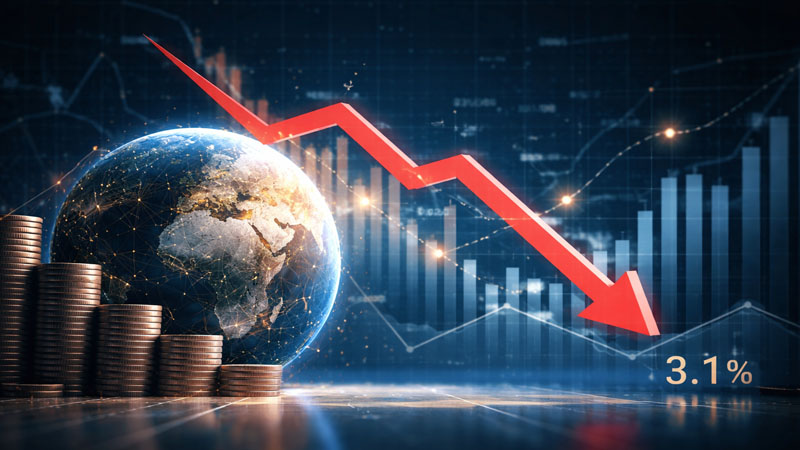
International desk: The global economy is moving into a period of slower and more fragile expansion, as the momentum from the post-pandemic recovery continues to fade and long-standing structural challenges come into sharper focus. According to the International Monetary Fund’s (IMF) World Economic Outlook, October 2025, global gross domestic product (GDP) growth is expected to moderate from 3.3% in 2024 to 3.2% in 2025, before easing further to 3.1% in 2026.
The latest projection by the IMF emphasises an important shift in the global outlook: growth is no longer being supported by cyclical rebound effect but is increasingly constrained by high interest rate, weaker productivity, trade fragmentation and rising economic risk. The Fund warns that the world economy could face a prolonged period of subdued growth and elevated vulnerability without decisive policy action.
Advanced economy is projected to experience the sharpest slowdown, with average growth expected to remain around 1.5% in 2025. Persistently tight monetary conditions, aimed at restoring price stability, are weighing on investment and consumers’ demand. At the same time, structural issues- like aging populations, labour shortage and slow productivity gains- are limiting the economy’s capacity to expand.
With fiscal space constrained by high public debt and monetary policy still focused on inflation control, policymakers in advanced economies face difficult trade-offs between supporting growth and maintaining macroeconomic stability.
Emerging market and developing economy is forecast to maintain relatively stronger growth, averaging slightly above 4%. However, the IMF stresses that this performance remains below historical norm and well short of what is needed to support faster income convergence and development goals.
External headwinds- including weaker global demand, trade barriers, and volatile capital flows-are combining with domestic challenges like infrastructure gap, skill bad fit and governance constraint. Although the global economic center of gravity continues to shift toward the economy, the pace of that transition is proving slower and more uncertain than expected.
On inflation, the IMF offers a measured note of optimism. Global inflation is projected to fall to 4.2% in 2025 and to 3.7% in 2026, reflecting the cumulative impact of tighter monetary policy and easing supply-side disruption. This trend provides some relief to households and policymakers.
However, the Fund cautions that easing inflation does not eliminate economic risks. High levels of public and private debt, rising borrowing cost, geopolitical tension and the risk of sudden asset price correction- particularly in highly valued sectors- continue to threaten economic stability. Any significant market disruption could quickly spill over into the actual economy, undermining growth and confidence.
Beyond near-term cyclical pressure, the IMF underscores deeper structural forces that are reshaping the global economy. The spread of protectionist policy and trade restriction is weakening the global supply chain and dampening cross-border investment. At the same time, slow productivity growth and persistent labour market inefficiency is limiting economies’ long-term growth potential.
The fading benefits of earlier trade- and investment-driven expansion have made the weakness more visible, reinforcing concern that global growth could settle at a lower trajectory without meaningful reform.
The emerging macroeconomic environment carries important implications for the insurance sector, a key pillar of economic stability. In several regions, the normalisation of bond yield curves has improved insurers’ investment income, strengthened capital position and supported more accurate pricing of long-term products.
However, prolonged market volatility or renewed uncertainty could pose challenges. Declining asset values, weaker investment returns and more complex asset-liability management- particularly for long-duration insurance products sensitive to interest rate and inflation movements- could strain balance sheets. Strong diversification, high-quality assets and disciplined risk management remain critical safeguard.
Despite the subdued outlook, the IMF highlights that the existing situation also presents an opportunity for decisive and coordinated policy action. Revitalising global trade through dialogue and cooperation, executing deep structural reform and boosting productivity through technology adoption, skills development and innovation could help restore growth momentum.
In a world of slower expansion and heightened uncertainty, the message by the IMF is clear: policy consistency, institutional credibility and global cooperation are indispensable. Without them, the risks of stagnation and instability will intensify. With them, the global economy may still lay the groundwork for more resilient, sustainable and inclusive growth in the years ahead.
.jpg)