Income Insurance and WWF Launch Eco-Friendly Takeaway System
International Desk: Income Insurance and the World Wide Fund for Nature Singapore have joined forces to introduce Eco Dabao, the city-state’s first public return-and-reuse system for takeaway food and drink containers in the bustling Central Business District. The initiative, which translates to ‘eco takeaway,’ seeks to reduce the flood of single-use packaging waste generated daily by office workers and visitors in one of Singapore’s busiest lunch hubs.
The five-month pilot programme, running until September 2026, marks a practical step toward normalising reusable habits in a fast-paced urban environment where awareness of sustainability often fails to translate into daily action. By making reuse convenient and rewarding, Eco Dabao aims to divert thousands of disposable containers from landfills while gathering valuable data on user behaviour for potential wider rollout.
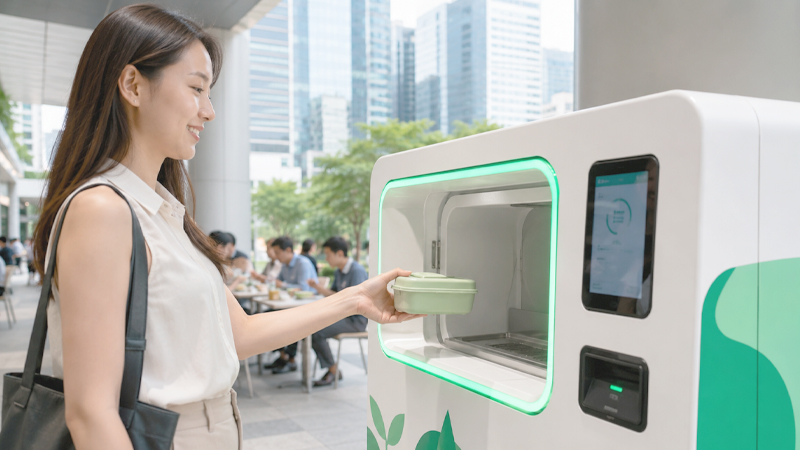
Users simply borrow durable, returnable food containers or beverage cups from participating food and beverage outlets at no extra cost or deposit. After their meal, they can return the items at any of the five smart return stations strategically placed across high-traffic CBD locations, including Bank of Singapore Centre, One Raffles Place, OCBC Centre, Republic Plaza and UOB Plaza 2. The system’s flexibility allows returns at any station regardless of where the food was originally purchased, removing a common barrier to participation.
The programme is powered by Muuse, which handles the technology, logistics, professional cleaning and infrastructure. Containers and cups, made of food-safe polypropylene, are designed for up to 1,000 uses and can accommodate both hot and cold items while being safe for microwave and dishwasher cycles.
Users do not need to wash the items themselves. Smart stations provide real-time monitoring to ensure efficient collection and hygiene standards are maintained at a central facility. Halal compliance is supported through colour-coded containers and separate processing streams.
To encourage adoption, the programme offers a straightforward incentive system. Participants scan a QR code upon return to unlock rewards such as S$2 vouchers from popular outlets like Kopitiam, KFC and Yindii, along with discounts from partners including Prefer Coffee and foodpanda perks. Integration with the foodpanda platform further extends accessibility for selected orders.
Initially, around eight to nine F&B brands are participating, including Cedele, Cha Re Re, Greendot, Patrons’, Poke Theory, Souperstar, The Backyard Bakers and Upshot Specialty Coffee. Plans call for expansion to about 15 outlets by July 2026. Property owners in the CBD have supported the placement of return stations, creating a true ecosystem collaboration involving insurers, environmental organisations, technology providers, F&B operators and real estate partners.
Income Insurance serves as the anchor funder, building on its longstanding zero-waste advocacy. The programme draws funding and momentum from the annual Income Eco Run, where every kilometre completed by participants generates a S$1 donation to green causes. In its earlier workplace pilot across Income offices starting in April 2026, nearly 500 containers were borrowed and returned within the first month, demonstrating strong internal uptake.
Andrew Yeo, CEO of Income Insurance, highlighted the importance of bridging intention and action. He noted that while many Singaporeans care about sustainability, the real challenge lies in embedding it into everyday routines. By extending the system from internal offices into the public CBD space, the partnership aims to make reuse a normalised behaviour rather than an occasional choice.
Eco Dabao shows that, with the right infrastructure and partnerships, reuse can become both viable and convenient for busy urban dwellers.
The initiative aligns closely with national efforts, including Singapore’s Zero Waste Masterplan, the Green Plan 2030, and campaigns by the National Environment Agency and Ministry of Sustainability and the Environment. Singapore generates substantial volumes of disposable takeaway packaging annually, contributing to landfill pressures and relatively low recycling rates for food-contact items. During the pilot, organisers target the avoidance of more than 10,000 single-use disposables.
.jpg)