Why Crop Insurance Remains Unpopular in Haor Regions
Raj Kiron Das: Farmers in Bangladesh's haor region face increasing uncertainty regarding boro paddy, the primary crop and livelihood for thousands in the northeast.
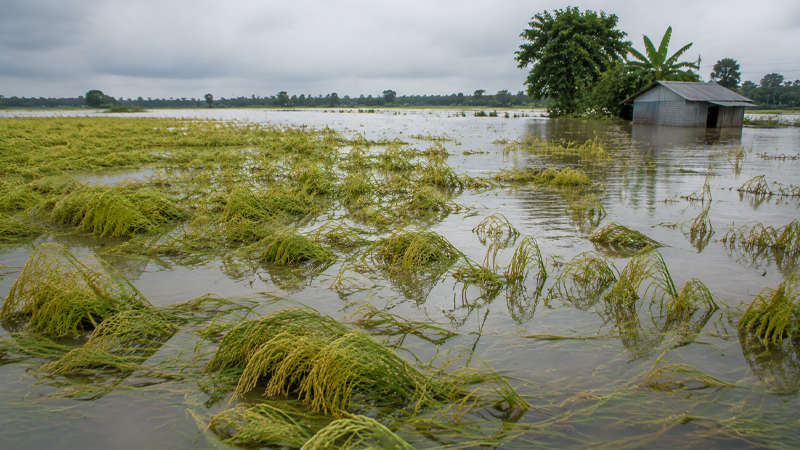
In early May, heavy rainfall, floods and water from upstream areas submerged vast tracts of paddy fields in Sunamganj, Kishoreganj, Netrokona, Sylhet and other haor districts. Preliminary reports suggest that nearly 100,000 hectares of boro land across seven haor districts have been affected, impacting approximately 150,000 farming families. In Sunamganj and Kishoreganj alone, damages are reported to have exceeded Tk 500 crore.
According to Reuters, citing the Department of Agricultural Extension, over 46,000 hectares of land in the northeastern haor region have been inundated, sparking fears of a boro production shortfall exceeding 200,000 tonnes.
Despite facing these risks almost every year, most haor farmers remain outside the protection of crop insurance. Field-level reports indicate that over 95% of farmers in the region lack insurance coverage, leaving them vulnerable when a season’s crop is damaged.
For many haor families, boro paddy is not just a crop; it is the cornerstone of their food security, income, debt repayment, education and daily survival. The loss of this crop has a year-long impact.
Bangladesh has launched pilot projects for weather index-based crop insurance, but these have not reached farmers on a large scale. Green Delta Insurance and Pragati Insurance have introduced weather index-based insurance for small and marginal farmers. These programs offer protection against risks such as excessive rainfall, drought and temperature-related crop damage, including to boro paddy.
This system links compensation to weather data from satellites and ground stations. If weather conditions exceed predefined risk thresholds, farmers can receive compensation quickly, bypassing the need for time-consuming individual damage assessments.
However, crop insurance remains unpopular among haor farmers for several key reasons.
Lack of understanding
The primary issue is the lack of understanding. Many small and marginal farmers are not fully aware of how crop insurance works. They fear they will not receive compensation after paying premiums or worry about complicated claims processes. Despite pilot initiatives by Sadharan Bima Corporation, Green Delta Insurance, Pragati Insurance and others, limited awareness campaigns and field-level explanations have hindered farmers from fully comprehending the benefits of insurance.
Trust issues
Trust is another significant barrier. Farmers urgently need cash assistance when their crops are damaged, as they must repay loans, pay laborers and cover family expenses. Traditional insurance systems take time to process claims. Although weather index-based insurance can provide quicker payouts, some farmers question whether satellite data accurately reflects the actual damage on the ground, which undermines their trust in the system.
High premium costs
Premium costs also pose a challenge. The haor region is highly vulnerable to floods, making insurance premiums expensive. For instance, in pilot programs, the premium for boro crop insurance ranges from 5% to 8% of the insured amount. For a crop valued at Tk 12,000 per acre, farmers may have to pay Tk 600 to Tk 900 in premiums. For many poor farmers, this is an additional burden on top of seed, fertilizer, irrigation and labor costs.
Land ownership complications
Land ownership further complicates matters. Many haor farmers are sharecroppers or landless cultivators. They work on land owned by others but may struggle to access insurance because registration often requires land ownership documentation. As a result, the actual cultivators suffering the damage may be excluded from insurance coverage. Experts stress that for crop insurance to be effective, it must include not only landowners but also sharecroppers and tenant farmers.
Limited government support
Limited government support is another major challenge. While crop insurance has been discussed at various levels, it has yet to expand beyond pilot projects. In many of these pilots, international agencies, development partners, or NGOs cover a large portion of the premium, but without a long-term government subsidy structure, crop insurance remains unaffordable for most farmers.
Persistent risks
The risk pattern in the haor region has been consistent over the past five years. In 2022, floods devastated crops in Sunamganj, Sylhet and Netrokona. In 2023, sudden water flow at the end of April damaged crops across several thousand hectares. 2024 saw favorable weather, sparing farmers from major losses, while in 2025, and excessive rainfall caused damage in low-lying areas. In 2026, farmers again faced significant losses due to early floods and heavy rains in May.
Government response
In response to the current crisis, the Ministry of Agriculture has announced financial support for affected farmers, with plans to provide Tk 7,500 per month to farmers in the first phase. Additionally, a long-term project worth Tk 1,429 crore has been initiated to excavate rivers and canals in Netrokona and Sunamganj, with completion expected by 2029.
The need for affordable, reliable insurance
Experts argue that embankments alone are insufficient to protect haor agriculture. Climate change, floods, excessive rainfall and upstream water flows have made the region more vulnerable. Farmers need an affordable, simple and reliable crop insurance system to help mitigate the risks.
A public-private partnership model is essential for overcoming these challenges. Government agencies, insurance companies, banks, NGOs and local farmers’ organizations must collaborate to make crop insurance more accessible. Key improvements include government subsidies for premiums, including sharecroppers in coverage, simplifying registration, offering mobile-based claim settlement and launching robust awareness campaigns.
For haor farmers, crop insurance is not just a financial product; it is a practical tool for recovery after disaster. To make crop insurance popular, however, the system must first build trust, reduce premium costs and ensure timely compensation.

.jpg)