Singapore Insurance Market Expands Amid Rising Claims Costs
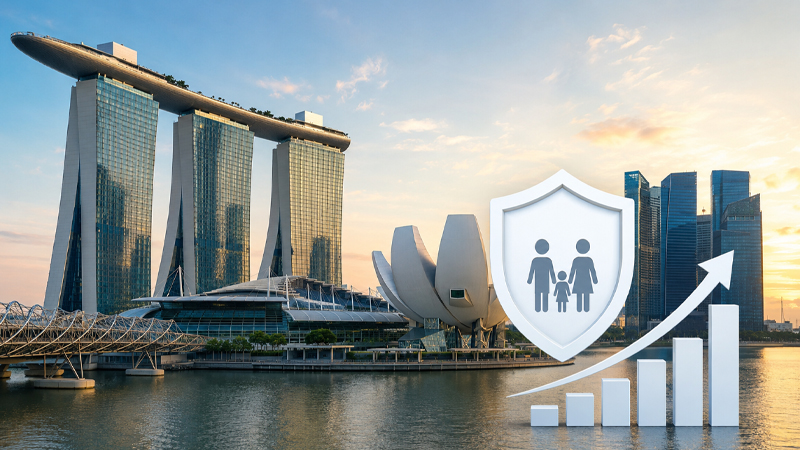
By International Desk: Singapore’s insurance market is growing steadily. In 2025, the general insurance sector recorded a gross written premium of S$6.09 billion, up 8.4% from the previous year. This is the first time the market has crossed the S$6 billion mark.
Combined domestic and offshore premiums rose 3.7% to S$11.2 billion, while life insurance new business premiums reached S$6.53 billion in total weighted terms, up 11.3%, reflecting sustained demand for wealth, retirement and protection solutions.
The market’s growth is supported by strong regulatory oversight, digital innovation and a mature financial ecosystem. However, rising claims severity in motor and property segments continues to pose challenges for insurers.
Singapore’s insurance landscape combines compulsory public schemes with a wide range of private products, resulting in one of the highest insurance penetration rates in Asia. Life insurance offerings include term, whole life, endowment, unit-linked and investment-linked plans, catering to needs such as death protection, critical illness coverage, retirement planning and wealth accumulation.
On the non-life side, general insurance products include motor insurance, where third-party liability is mandatory, along with comprehensive coverage for accidents, theft and own damage. Property and fire insurance protect buildings and contents against risks such as fire, storms and floods. Health and medical insurance policies supplement MediShield Life, while additional offerings include personal accident, workers’ compensation, liability (public, product and professional indemnity), marine and aviation, engineering and emerging solutions such as cyber and embedded insurance.
Mandatory insurance requirements play a key role in the system. These include motor third-party liability under the Motor Vehicles (Third-Party Risks and Compensation) Act, Work Injury Compensation Insurance for lower-income and manual workers and medical insurance for Work Permit and S Pass holders. Personal accident coverage is also required for migrant domestic workers.
The regulatory framework, overseen by the Monetary Authority of Singapore under the Insurance Act, places strong emphasis on transparency, fair treatment and full disclosure. Insurers are required to clearly highlight exclusions, limitations and conditions, while policyholders must disclose all material information. Non-disclosure or misrepresentation may result in reduced payouts or policy avoidance.
Claims activity in Singapore is driven largely by motor accidents, with severity rising due to higher repair costs, parts inflation and the increasing complexity of electric vehicles. Property claims have also increased, particularly from fire incidents and weather-related events. Health insurance claims continue to grow amid medical inflation and higher utilisation rates, while liability and personal accident claims typically arise from workplace and public incidents.
Claim denials most commonly result from non-disclosure, late notification, policy exclusions, fraud, or incomplete documentation. However, strict regulatory oversight ensures that claims are handled fairly and within defined timelines, with ambiguities generally interpreted in favour of the insured.
Premium pricing remains risk-based and competitive. Motor insurance, the largest general segment, recorded a 5.2% increase to S$1.28 billion, influenced by factors such as vehicle type, driver history and no-claims bonus structures. Property premiums rose 4.1% to S$864.1 million, while health insurance premiums increased 7.4% to S$1.24 billion, reflecting age, coverage levels and optional riders.
Life insurance premiums continue to depend on factors such as age, health status and sum assured, alongside investment-linked components. Overall premium rates are facing upward pressure due to claims inflation and rising reinsurance costs, although competition and digital pricing tools are helping to moderate increases.
Claim values vary widely, ranging from minor motor repairs and outpatient treatments below S$1,000 to large-scale property losses and complex medical cases reaching hundreds of thousands or even millions of dollars. Domestic net incurred claims rose 8.7% to S$1.8 billion in 2025, with significant increases in motor (11%) and property (60.5%) segments.
The market regulated by the Monetary Authority of Singapore and supported by industry bodies such as the General Insurance Association and the Life Insurance Association, remains highly competitive, with a mix of local and international players.
While challenges such as rising claims severity, medical inflation and climate-related risks persist, the sector continues to present strong opportunities in digital transformation, cyber risk protection and solutions tailored to an ageing population.

.jpg)