China Plans Major Capital Boost for Its Biggest Insurers with $29 Billion in Special Bonds
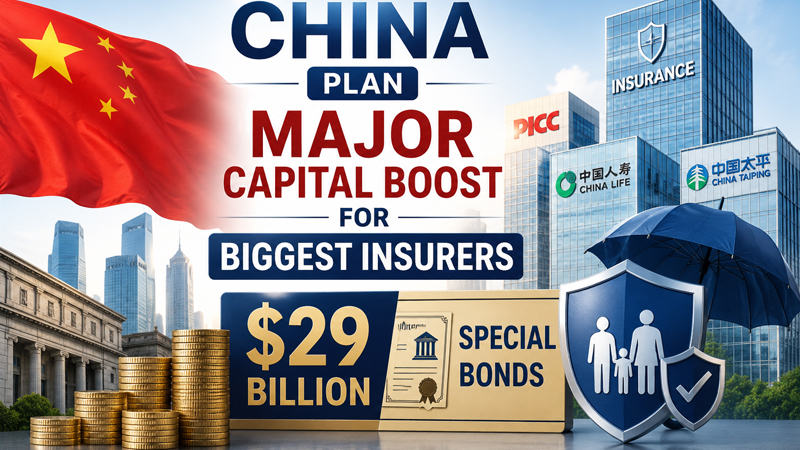
By International Desk: In a move aimed at strengthening the foundations of China’s insurance industry, the government is considering a significant capital injection into some of the country’s largest state-controlled insurers. According to reports from late January 2026, authorities are looking at selling special government bonds to raise around 200 billion yuan, or roughly $29 billion, which would then be used to recapitalize key players in the sector.
This plan targets major firms such as China Life Insurance Group, People’s Insurance Company of China (PICC), and China Taiping Insurance Group. These companies, which are ultimately controlled by the state, play a huge role in providing life insurance, property coverage, and other financial protections to millions of Chinese citizens and businesses. The fresh capital would give them stronger financial buffers, helping them weather challenges and potentially take on a bigger role in the market.
For ordinary people, this matters because insurance companies in China are not just about selling policies; they invest heavily in the economy, support retirement savings, and help cover risks from everything from car accidents to health issues and natural disasters. A stronger insurance sector can mean more reliable coverage and better stability for families and companies when things go wrong.
The insurance industry has been under pressure to consolidate; meaning smaller or weaker players may merge with or be absorbed by bigger ones. Over the past few years, some insurers have faced difficulties from volatile investment returns, rising claims, and stricter regulations. The big state-owned groups have already stepped in to help resolve problems at troubled smaller insurers, which used up some of their own resources. This new injection would replenish their strength and position them as anchors for a more stable, high-quality market.
What makes this announcement stand out is the method being used. It would be the first time Beijing has turned to special government bonds specifically to inject capital into insurers. The government has used this approach before to support big state-owned banks, showing how seriously officials view the need to bolster the financial system as a whole. Special bonds like these are essentially backed by the government and allow it to raise large sums without immediately straining regular budgets.
Details of the plan were still under discussion when the news broke, with sources speaking on condition of anonymity because the matter was private. The affected insurance companies themselves declined to comment at the time. If it goes ahead, the move would send a clear signal of government support for the sector at a time when China is also pushing broader economic stability measures.
Analysts see this as part of a longer-term strategy. With an aging population and growing middle class, demand for life insurance, health coverage, and retirement products continues to rise. At the same time, regulators want a cleaner, more professional industry with fewer risks. Stronger capital positions for the giants should help them expand responsibly, adopt new technologies like artificial intelligence for faster claims, and better protect policyholders.
For investors, the news was generally positive. Shares of listed units of these insurers rose in the period following the reports, reflecting confidence in their future outlook. However, the broader industry still faces challenges such as competition, economic slowdown effects, and the need to manage climate-related risks that can lead to big payouts.
.jpg)