French Court Convicts Airbus and Air France, Raising Questions about Aviation Insurance
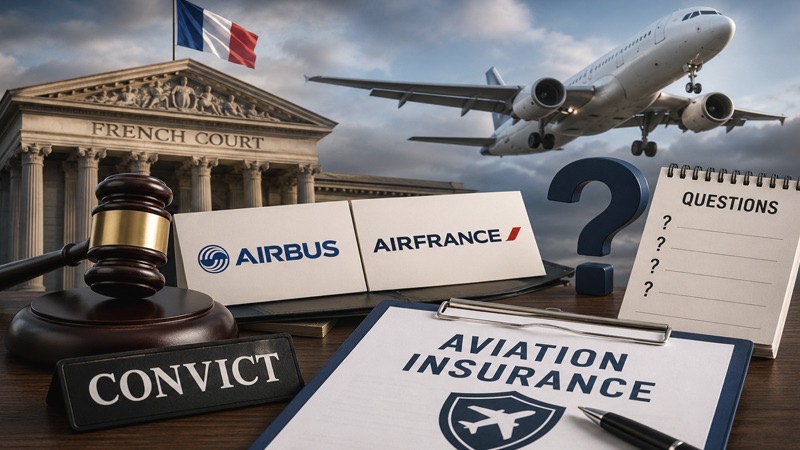 By International Desk: More than 16 years after one of the deadliest accidents in French aviation history, a Paris appeals court has delivered a landmark ruling that holds both the aircraft maker Airbus and the airline Air France responsible for the loss of Flight AF447. On May 21, 2026, the court convicted the two companies of involuntary manslaughter or corporate manslaughter, over the crash of the Airbus A330 jet that plunged into the Atlantic Ocean on June 1, 2009, during a flight from Rio de Janeiro to Paris. All 228 people on board perished in the tragedy.
The verdict marks a dramatic reversal of a 2023 decision by a lower court that had acquitted both companies. This time, judges ruled that Airbus and Air France were “solely and entirely responsible” for the disaster. Each company was ordered to pay the maximum fine allowed under French law for corporate manslaughter: €225,000, which is roughly $261,000. While that amount is relatively small for two giant corporations and has been described by many as largely symbolic, the conviction itself carries significant weight, especially for the families of the victims who have waited years for this kind of acknowledgment.
To understand what happened that night, it helps to recall the basic facts. The plane was flying through stormy weather when the pilots encountered problems with the aircraft’s airspeed sensors, known as pitot tubes, which can ice up at high altitudes. This caused the autopilot to disconnect, and the crew struggled to regain control. The jet eventually entered a stall and fell from the sky. Official investigations pointed to a combination of technical issues and how the pilots responded, but the criminal case focused on whether the companies had done enough beforehand to prevent such a tragedy. Prosecutors argued that Air France had not provided adequate training for this specific kind of sensor failure and that Airbus had not acted quickly enough on earlier warnings about the pitot tubes.
Both Airbus and Air France have said they will appeal the decision to France’s highest court, arguing that pilot error was the main cause and that the ruling contradicts earlier findings. For the families, the conviction brings a sense of justice even if the financial penalties feel inadequate compared to their loss. Many relatives described the outcome as recognition of systemic failures rather than just blaming the crew.
Beyond the human story, this ruling has broader ripples that ordinary people might not immediately see but that matter for air travel safety, costs, and accountability in the future. One key area is how it could affect aviation insurers and the complex world of product liability. When planes crash, insurance companies pay out large sums to cover the aircraft itself, passenger compensation, and legal costs. Airlines typically carry liability insurance for their operations, while manufacturers like Airbus have separate product liability coverage for issues linked to the aircraft design or systems.
In past cases, the division of blame between the airline and the manufacturer often determines who ultimately bears more of the financial burden. This verdict, by declaring both parties fully responsible, could shift how future claims are negotiated. Insurers may now look more closely at contracts that spell out how manufacturers indemnify airlines or how costs are shared. Underwriters who decide how much coverage to offer and at what price might become more cautious when assessing risks involving European carriers and aircraft makers. They could demand higher premiums or tighter wording in policies, especially around training standards, maintenance records, and how companies respond to known technical problems. If insurance costs rise because of heightened legal risks, those expenses could eventually filter down to ticket prices or affect how quickly new aircraft models are developed and certified.
.jpg)