Global Natural-Disaster Insurance Gap Surges Past $420 Billion
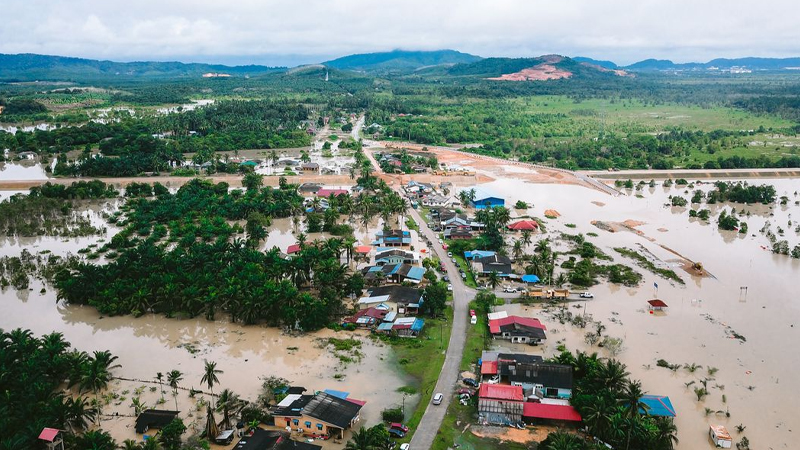
By News Desk: The global insurance protection gap for natural catastrophes has widened to a staggering $424 billion, according to the latest analysis from the Swiss Re Institute, underscoring persistent underinsurance that leaves economies, businesses, and households dangerously exposed to the escalating threats posed by wildfires, storms, floods, and other extreme weather events.
This figure, representing uninsured losses from 2025, marks a more than 7 percent increase from the prior year and reflects a troubling trend: even as insured losses reached record shares in some well-covered markets, the absolute scale of unprotected economic damage continues to grow alongside rising asset values and climate-driven perils.
In 2025, natural catastrophes inflicted substantial economic losses globally, with Swiss Re reporting around $220 billion in total impacts across nearly 190 events, of which insured losses accounted for approximately $107 billion representing nearly half of the total in a historic high for coverage penetration.
Yet this apparent progress masks profound regional disparities. North America emerged as the most exposed region, bearing the brunt of high-value insured and uninsured damages from events like severe convective storms and wildfires. In contrast, emerging markets and developing economies continue to face protection gaps of 80 to 90 percent, where the vast majority of losses fall directly on governments, communities, and individuals ill-equipped to absorb them.
This divide carries far-reaching implications. In vulnerable regions across Asia-Pacific, Latin America, and parts of Africa, underinsurance amplifies humanitarian crises and slows recovery. For instance, the 2025 earthquake in Myanmar generated an estimated $11 billion in economic losses and claimed thousands of lives, but insured payouts barely exceeded $200 million, leaving the bulk of reconstruction burdens on already strained public resources.
Historical patterns echo this reality: since 1980, global natural disaster losses have totaled trillions, with only about one-third insured overall and far less in developing nations. In Asia-Pacific alone, the protection gap has hovered near 88 percent, far exceeding the global average.
Several factors drive this enduring gap. Affordability remains a core barrier in lower-income countries, where insurance penetration is minimal and premiums for high-risk coverage often prove prohibitive. Risk misperception also plays a role; many homeowners and businesses underestimate the probability of disasters striking their areas, leading to low uptake even when products are available.
In advanced economies, issues like coverage exclusions for certain perils, rising premiums due to increased frequency and severity of events, and regulatory hurdles further complicate access. Climate change exacerbates these dynamics by intensifying secondary perils such as wildfires and convective storms which accounted for a record 92 percent of insured losses in 2025.
Projections suggest that at current trajectories, insured losses could climb toward $186 billion globally by 2030, but the uninsured portion is likely to expand in tandem unless systemic changes occur.
Experts emphasize that narrowing the gap requires multifaceted strategies. Adaptation and risk mitigation through stronger building codes, nature-based solutions, and infrastructure investments stand out as critical complements to insurance. Public-private partnerships, such as those promoted in G20 and IAIS discussions, can help design affordable parametric products and sovereign risk pools tailored to emerging markets.
Innovations like parametric insurance, which pays out based on predefined triggers rather than assessed damages, offer faster relief and greater accessibility. Insurers and reinsurers are also called upon to expand data-driven underwriting, leverage technology for better risk modeling, and collaborate on resilience-building initiatives that make coverage more viable and sustainable.
.jpg)