High Risks of Cheap Premiums from Incorrect Building Insurance Class
Mashrukh Khan: In the bustling urban centers and expanding industrial zones of Bangladesh, where fires, floods, and cyclones pose persistent threats to homes, shops, factories, and warehouses, the correct classification of buildings under the national fire insurance tariff has emerged as a critical financial and protective decision for property owners. Regulated by the Insurance Development and Regulatory Authority (IDRA) through the Bangladesh Fire Tariff, these classifications directly determine premium rates, the scope of coverage, and the likelihood of successful claims, yet many owners remain unaware of the high stakes involved in getting it right.
Buildings in Bangladesh are typically grouped into four main construction classes for fire and allied perils insurance, reflecting the materials used and their resistance to fire and other hazards. First Class structures, often fully concrete or reinforced pucca buildings, represent the highest standard of fire resistance and command the lowest premium rates. Second Class buildings, featuring brick walls with metal sheet roofs, sit in the middle tier. Third Class properties rely more heavily on metal sheet construction, while Fourth Class buildings—constructed with highly combustible materials like bamboo, mats, or temporary sheets—face the steepest premiums due to elevated risk.
The financial implications are substantial. Premiums are calculated as a percentage of the sum insured, with rates varying not only by class but also by occupancy—whether residential, commercial, industrial, or storage—and additional perils covered. For instance, tariff examples show rates for certain risks starting as low as 0.12% for Second Class buildings in lower-hazard scenarios, climbing to 0.19% or higher for Third Class, with First Class structures enjoying noticeable discounts. A factory or warehouse valued at Tk 10 crore could see annual premiums differ by tens or even hundreds of thousands of Taka depending on its assigned class, especially when factoring in extensions for riot and strike damage, flood, cyclone, or earthquake. Separate valuations for the building itself, machinery, and stock further refine these costs, and large industrial risks exceeding country limits often involve international reinsurance with additional loadings.
Choosing the right class offers clear advantages in both cost and coverage. Owners of First Class buildings benefit from lower base rates and easier qualification for discounts through features like sprinklers, fire alarms, or adequate separation from neighboring structures. This translates to more affordable protection while ensuring broader, more reliable coverage when disasters strike. Accurate classification encourages safer construction practices, aligning with the Bangladesh National Building Code and reducing overall societal vulnerability to fires that frequently ravage densely populated areas. In an economy where small and medium enterprises dominate, securing optimal premiums frees up capital for growth rather than excessive insurance outlays.
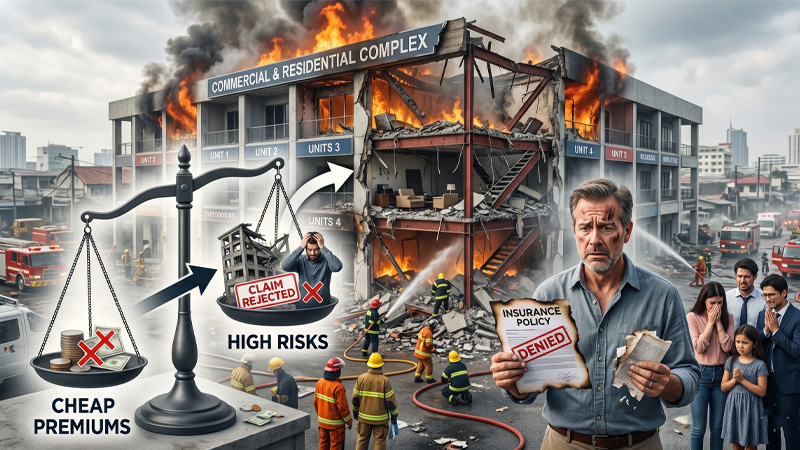
However, the risks of misclassification or opting for a lower class to cut short-term costs are severe and multifaceted. Under-declaring a building’s true construction quality—say, insuring a robust concrete structure as Third or Fourth Class—might yield immediate premium savings but can trigger the application of the average clause during claims. This pro-rata reduction means policyholders recover only a fraction of their losses if the sum insured does not match the actual risk profile, leaving them financially devastated after a fire or storm. Conversely, over-classifying a vulnerable bamboo or sheet-metal building as First Class risks policy disputes, claim denials, or even accusations of misrepresentation, which insurers scrutinize through mandatory site surveys and detailed documentation.
Real-world implications ripple across sectors. A shop owner in a commercial hub who underestimates his building’s combustibility might face skyrocketing out-of-pocket repairs after an electrical fire, common in Bangladesh’s aging infrastructure. Industrial plants with hazardous materials stored in lower-class structures could see premiums balloon or coverage restricted, while rural homeowners in temporary dwellings often struggle with prohibitively high rates or limited insurer appetite. In multiple-occupancy buildings, the highest-rated portion often dictates the rate for the entire property unless separated by proper party walls, amplifying the cost of errors.
Experts emphasize that the consequences extend beyond individual finances. Widespread misclassification contributes to underinsurance across the market, straining the insurance industry’s ability to respond to major events like the frequent seasonal floods or urban blazes. It also discourages investment in fire-resistant upgrades that could lower national disaster recovery costs. With IDRA mandating adherence to the tariff and requiring detailed annexures for rates on buildings, machinery, and stock, transparency during policy inception is non-negotiable. Property owners are advised to engage licensed surveyors, provide accurate plans and photos, and consult insurers or brokers for precise quotations tailored to their specific location, occupancy, and protections.
As Bangladesh continues its rapid urbanization and industrial growth amid climate vulnerabilities, the importance of precise building classification in insurance cannot be overstated. It stands as a pivotal intersection of risk management, regulatory compliance, and economic resilience. Property owners who invest the time to understand and correctly apply these classes not only secure more affordable and comprehensive coverage but also safeguard their futures against the unpredictable perils that define life in this dynamic nation. Those uncertain about their building’s status would do well to seek professional assessment promptly, turning potential liability into a strategic advantage.

.jpg)