
Non-life insurance policies issued with forged money receipts: Risk of fund misappropriation, policyholders at risk
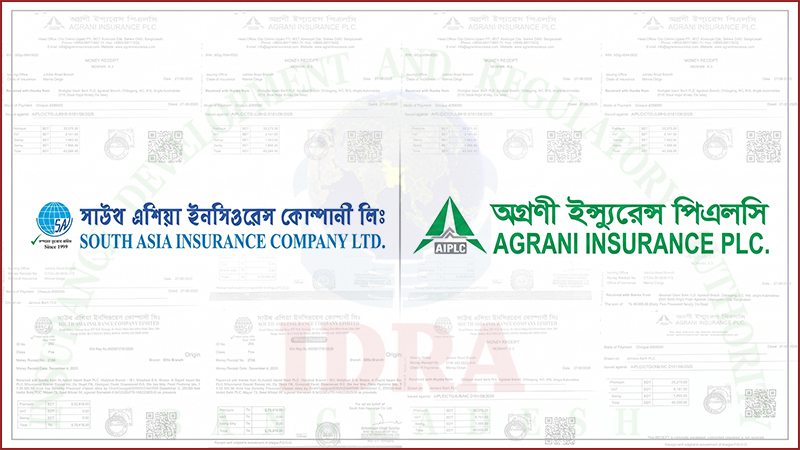
Abdur Rahman Abir: Some dishonest groups in the country’s non-life insurance sector have adopted a new strategy of fraud to evade digital surveillance. Completely forged and digitally manipulated “e-receipts” or money receipts are being created so that large amounts of policyholders’ premium money are not deposited into the company’s bank account and can instead be directly misappropriated.
An investigation by Insurance News BD has revealed information on under-rating and premium concealment by bypassing the central server directed by the Insurance Development and Regulatory Authority (IDRA). Such a picture of fraud has been found in the preliminary analysis of two money receipts issued in the names of South Asia Insurance and Agrani Insurance.
Concerned persons fear that internal dishonest officials of the companies, agents, or powerful broker syndicates are involved behind this. The matter constitutes fraud under the Penal Code and a clear violation of the Insurance Act, 2010.
According to them, because of the forged money receipts, the premium money is not deposited into the company’s fund, so no insurance contract or policy becomes legally effective. As a result, if any major loss occurs in the future, the policyholder’s insurance claim of crores of taka is directly cancelled and they face severe financial loss.
According to information, to ensure transparency and accountability, from 1 October 2021 IDRA completely banned traditional handwritten or ordinary printed money receipts of non-life insurance companies. After a trial period from 1 June to 30 September of the same year, the then UMP (currently IIMS)-based online QR code-linked digital e-receipt system was made mandatory.
However, in response to the demand of the Bangladesh Insurance Association, the organisation of insurance owners, IDRA stepped back from this decision. Later, by gradually advancing the digitisation activities of insurance companies, implementation of the decision began from 1 January 2022.
As per the rules, scanning this code should directly verify the authenticity of the policy on IDRA’s Insurance Information Management System (IIMS) or central server. However, the investigation has found evidence of violation of this rule in the two receipts of South Asia Insurance and Agrani Insurance.
Fraud and Legal Violation by South Asia Insurance
A review of a money receipt issued by South Asia Insurance for a fire policy, obtained by Insurance News BD, shows that it does not even contain any QR code as directed by IDRA. The absence of a QR code on a receipt issued under the digital system is a direct violation of the regulatory authority’s order and is the strongest evidence that the receipt is forged.
This money receipt was issued on 4 December 2023 from the Elite Branch of South Asia Insurance, with number 3708. Through this money receipt, a premium of 5 lakh 70 thousand 16 taka was collected from the policyholder.
This forged money receipt bears the seal and signature of the company’s DMD and Head of Branch, Mohammad Abdul Kader. The money receipt issued against policy SAIC/ELI/FC-1153/12/2023 also has a seal marked “Original.”
Digital Manipulation by Agrani Insurance
On the other hand, a money receipt of 45 thousand 96 taka for a marine cargo insurance policy of Agrani Insurance has come into the possession of Insurance News BD, with number CTG/JUBI-2026-173. It was issued on 27 August 2026 from the company’s Jubilee Road Branch in the name of Ample Automobiles. The policy number for this marine cargo insurance is AIPLC/CTG/JUBI-0151/08/2026.
Although a QR code has been used on this money receipt of Agrani Insurance, scanning it does not provide any information from IDRA’s UMP (currently IIMS) server as required. Instead, the words “Giant QR Code Generator” appear. In other words, this “e-receipt” or money receipt of Agrani Insurance has been created through digital manipulation.
Under-Rating – Fake Policies, Government Deprived
Sector insiders say that one of the main tools of unethical competition in the insurance sector is “under-rating” or issuing policies at a premium lower than the prescribed tariff. Fake money receipts are mainly used to cover up the crime of under-rating or making policies disappear.
The investigation shows that although a large-amount money receipt is issued to the policyholder according to the tariff rate, the policy is entered on the company’s own server showing a very nominal premium through under-rating. The remaining large amount of money has been pocketed by the dishonest syndicate.
As a result, on one hand policyholders face the extreme risk of being deprived of insurance claims against their actual risk; on the other hand the state is losing huge revenue. Although 15% VAT and stamp duty are mentioned in the documents, due to under-rating and fake policies this VAT and tax money is never deposited into the government treasury.
What the Insurance Companies Say
Regarding the forgery of money receipts and violation of the law, Chief Executive Officer of South Asia Insurance Mohammad Nurul Alam Chowdhury said: “The money receipt in question is not forged; it is correct. We have verified that a policy has been issued against this money receipt and the premium money has been deposited into the company’s bank account. Perhaps some previously printed money receipts were with someone and it was issued from there; however, this is not right.”
The official of South Asia Insurance who signed this illegal money receipt, DMD and Head of Branch Md. Abdul Kader, has also admitted the matter to Insurance News BD.
Chief Financial Officer (CFO) of Agrani Insurance Md. Humayun Kabir Shimul said on this matter: “The company never issues forged money receipts. Because forged money receipts cause loss to the company itself. Rather, we are trying to catch these criminals; but we cannot. Some dishonest insurance workers and bank officials collude to create these forged money receipts. We have received complaints that the issuance of such fake policies is higher especially in border areas. We had received such complaints before as well.
However, we have not been able to identify who creates these forged money receipts and deposits them in the bank. Because the concerned bank officials are not cooperating with us. If we push the matter too much, the bank may stop giving us business. But we have filed a complaint about the matter with the BFIU. Although this complaint was made in 2025, we have not yet seen much activity from there.”
IDRA Will Take Action on Money Receipt Forgery
Spokesperson of the Insurance Development and Regulatory Authority (IDRA) Sadiq Arman said: “The authority will investigate the incidents of money receipt forgery and take necessary action against those involved. At the same time, initiatives will be taken to more widely publicise the method of verifying insurance policies on the IDRA portal immediately after accepting them, with the aim of increasing policyholders’ awareness.”

.jpg)
.jpg)