Insurance Protection Still Limited for Families near the Sundarbans
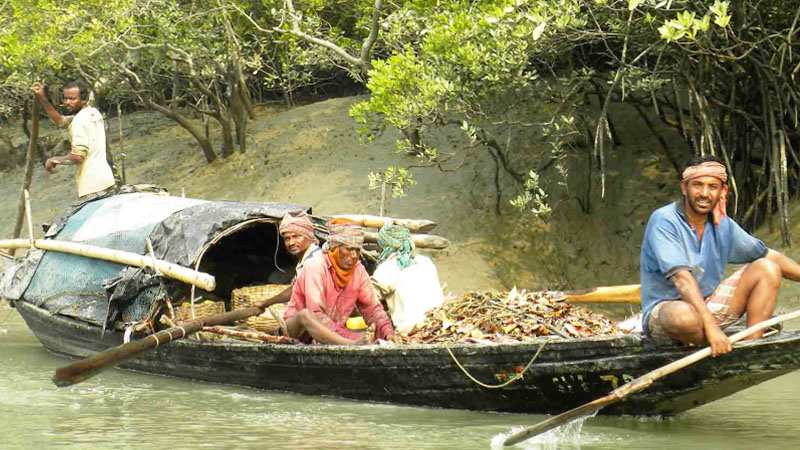
Raj Kiron Das: Belayet Sardar knows about insurance. But he says that although people living near the Sundarbans are familiar with it, insurance has yet to become a common way for families to recover from losses caused by cyclones and tidal surges.
Around 745,000 people live in Koyra and Dacope upazilas of Khulna and Shyamnagar upazila of Satkhira, according to Bangladesh’s 2022 Population and Housing Census. The three upazilas have about 188,000 households.
Cyclones can damage homes, crops, fish farms, livestock and boats, while also cutting off sources of income.
Satkhira-based teacher Mohammad Arabuzzaman said Cyclone Aila, which struck on 25 May 2009, damaged homes, drinking-water sources and livelihoods.
He said saline water entered many areas, leaving families to repair their homes while also finding food, safe water and new ways to earn money.
A study of 270 Aila-affected households in Koyra and Shyamnagar found that families with at least one member who moved elsewhere for work suffered an average financial loss of about $345.
Among households where no member moved elsewhere for work, the average loss was about $288.
The losses included damage to homes, agriculture, fish farms, livestock, vehicles and small businesses.
To cope, 41% of households in the first group and 45% in the second borrowed money. About 31% and 25% respectively sold assets.
Others used savings or looked for alternative work.
The study said such measures may help families deal with an immediate crisis, but repeated disasters can increase financial pressure.
After Cyclone Aila, the government, NGOs and development agencies provided food, safe water, sanitation, shelter, healthcare and agricultural support.
But the study did not estimate how much of the families’ total financial losses were covered by that assistance.
There is no comprehensive public data showing how many households or assets in Koyra, Dacope and Shyamnagar are insured.
Study points to insurance gap
A 2025 study highlights how limited insurance coverage can be among low-income families exposed to climate risks.
It surveyed 318 households in Koyra, Shyamnagar and Monirampur. None had insurance to protect them from financial losses caused by disasters.
Researchers said low incomes and limited alternative sources of earnings were among the main barriers to buying insurance.
However, the findings do not represent the overall insurance rate in the wider Sundarbans region because the study focused on selected low-income and climate-vulnerable households, including families from several high-risk unions in Koyra and Shyamnagar.
Insurance use remains low across Bangladesh
According to Bangladesh Bank’s Financial Stability Report 2025, insurance penetration stood at 0.34%.
Insurance penetration measures total insurance premiums as a share of a country’s gross domestic product.
The report said the claim settlement rate in the non-life insurance sector, based on the number of claims, fell to 28.51% in 2025 from 33.74% in 2024.
Non-life insurance includes fire, marine, motor and other forms of cover for property and related risks.
Bangladesh Bank said low claim settlement rates can weaken public confidence in insurance.
Climate-related insurance products exist
Bangladesh has insurance products for agriculture, fisheries, livestock and cyclone-related risks.
Green Delta Insurance offers agricultural, livestock and fisheries insurance. It also runs a pilot index-based microinsurance programme for small fish farmers in Khulna, Satkhira and Bagerhat.
Phoenix Insurance offers cover for some cyclone-related losses.
The number of people covered by these products in Koyra, Dacope and Shyamnagar has not been publicly disclosed.
Some schemes use index-based, or parametric, insurance.
Under this system, payment is triggered when a measure such as rainfall or water level reaches a set point. The insurer does not always need to assess each customer’s individual loss before making a payment.
This can speed up payments after a disaster.
Jamuna flood scheme offers another model
A different approach is already being used in flood-prone areas elsewhere in Bangladesh.
In 2026, about 100,229 households in Gaibandha, Kurigram and Sirajganj were brought under an index-based financial protection programme, covering around 420,000 people.
One part of the programme is parametric flood insurance.
For the 2026 flood season, it provides up to $6m in coverage.
A separate Community Protection Fund is intended to support communities during smaller floods and in cases not covered by the insurance.
National microinsurance framework in development
The Insurance Development and Regulatory Authority, or IDRA, and the United Nations Development Programme are also working on a national microinsurance framework.
Microinsurance is designed to provide simpler, lower-cost insurance for people with low incomes.
IDRA is looking at ways to reach people outside the formal insurance system, including through partnerships with microfinance institutions and other organisations.
It is not yet clear how the planned framework will address the risks faced by families near the Sundarbans, including losses to homes, farms, fish farms, livestock, boats and livelihoods.
No comparable large-scale scheme has been publicly announced for the Sundarbans coast, where cyclones and tidal surges remain a major risk.
.jpg)