South Asia’s Insurance Fraud Trap Raises Risks for Bangladesh
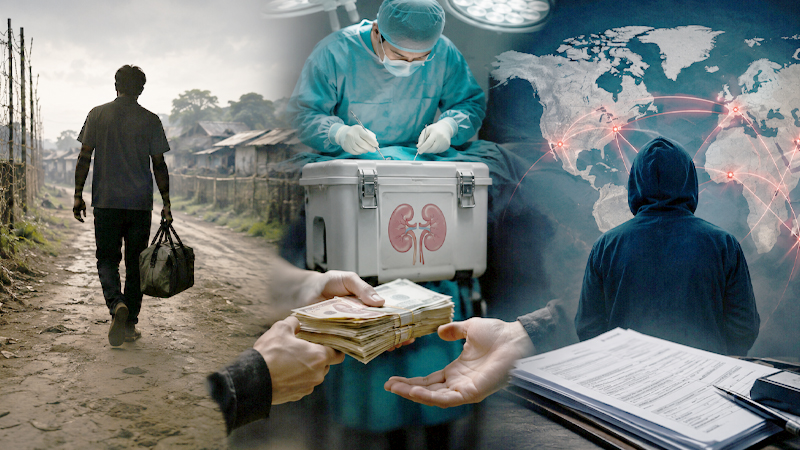
Staff Correspondent: A dangerous convergence of organised crime is unfolding across South and Southeast Asia, where human organ trafficking is increasingly intersecting with life insurance fraud. What were once separate criminal activities are now evolving into a complex and coordinated network that combines human exploitation with financial deception. For Bangladesh, the warning signs are becoming increasingly difficult to ignore.
A Growing Global Shadow Economy
Global estimates from the World Health Organisation indicate that around 150,000 organ transplants take place each year. However, a significant share, between five and ten percent, are believed to involve illegal sources. This translates into thousands of illicit procedures annually, generating a shadow economy worth hundreds of millions to over a billion dollars.
Behind these figures lies a system driven by vulnerability, deception and weak regulatory oversight. What was once viewed primarily as a medical ethics issue has now evolved into a broader economic crime involving cross-border syndicates, forged identities and financial manipulation.
Emerging Threat to the Insurance Sector
One of the most concerning developments is the growing risk of life insurance fraud linked to these criminal networks. In several countries across the region, investigators have observed patterns where vulnerable individuals are unknowingly used to obtain insurance policies. Their deaths, disappearances, or in some cases, staged incidents, are later exploited to file fraudulent claims.
This emerging trend presents a serious challenge for insurers. Weak identity verification systems, limited data integration and gaps in regulatory oversight increase the risk of fraudulent claims going undetected. As insurance markets in South Asia expand and digitise, these vulnerabilities may become more exposed.
Bangladesh’s Vulnerability
In Bangladesh, structural gaps in digital verification systems and limited coordination between national databases heighten the risk of such schemes taking root. As the country continues to modernise its financial and insurance sectors, these weaknesses create opportunities for organised criminal networks.
The issue is compounded by underlying socio-economic conditions. Certain areas, such as Kalai upazila in Joypurhat district, have gained notoriety for the prevalence of kidney selling. Investigative reports suggest that a significant number of residents in some communities have been involved in organ sales, driven largely by poverty, unemployment and mounting debt.
Many individuals are lured by brokers with promises of quick financial relief. In reality, they receive only a fraction of the money paid by recipients, while the bulk of profits is captured by intermediaries and international syndicates operating behind the scenes.
Cross-Border Networks and How They Operate
These criminal networks often operate across borders. Victims are transported through frontier districts into neighbouring countries, where illegal transplant procedures are carried out. Forged documents and fabricated family relationships are commonly used to bypass legal restrictions.
Such operations are highly organised, involving recruiters, transport facilitators, medical intermediaries and financial handlers. Their coordinated structure makes detection difficult and allows the networks to operate with relative efficiency.
Drivers behind the Crisis
The growth of this crime is driven by a combination of economic and systemic factors. Poverty and debt continue to push vulnerable individuals toward risky decisions, while weak border controls allow traffickers to move people across regions with relative ease.
At the same time, gaps in digital infrastructure and identity verification systems make it difficult to detect fraud in both healthcare and insurance sectors. Social media has further amplified the problem, providing a platform for deceptive advertisements that promise jobs or financial opportunities but ultimately lead individuals into exploitation.
Impact on Individuals and the Insurance Industry
The consequences of these crimes are severe and far-reaching. Victims often suffer long-term health complications, while their families face ongoing financial and social hardship.
For the insurance sector, the risks are equally significant. Fraudulent claims can lead to substantial financial losses, potentially increasing costs for legitimate policyholders. Over time, such practices may also erode public trust in both healthcare institutions and insurance providers, creating broader systemic challenges.
The Need for Coordinated Action
Experts emphasise that addressing this issue requires a coordinated and multi-layered response. Strengthening intelligence sharing across borders, improving integration between national identification systems and insurance databases and enhancing monitoring of suspicious financial transactions are critical steps.
Equally important is raising awareness among vulnerable communities, ensuring that individuals understand the risks and are less susceptible to exploitation. Without such efforts, prevention will remain limited.
A Structural Challenge beyond Crime
The intersection of organ trafficking and insurance fraud reflects a deeper structural challenge. It is not only a matter of criminal activity but also a symptom of economic inequality, limited opportunities and gaps in governance.
For Bangladesh, the situation presents both a warning and an opportunity. Timely and decisive action could prevent the problem from escalating into a more entrenched crisis. Failure to act, however, risks allowing these networks to expand further, with serious consequences for vulnerable populations and the integrity of the country’s insurance sector.
.jpg)