Lightning Deaths Rise in Bangladesh, Insurance Coverage Remains Low
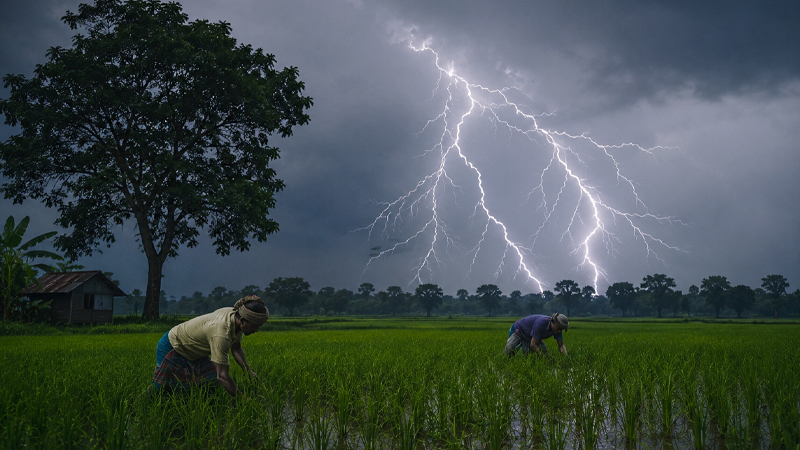
Staff Correspondent: Lightning has emerged as a silent yet deadly natural hazard in Bangladesh, claiming thousands of lives over the past decade and exposing a significant gap in financial protection for vulnerable communities.
According to data, more than 3,485 people died from lightning strikes between 2015 and 2024. The highest annual toll was recorded in 2020, when 427 people lost their lives. In 2026 alone, at least 72 deaths have been reported in the first four months, with the majority of victims being farmers working in open fields.
Research suggests that Bangladesh experiences between 8 million and 9 million lightning strikes each year. Around 70% of these occur between April and June, coinciding with the peak agricultural season. Studies further indicate that 60% to 70% of lightning-related fatalities involve farmers and rural labourers, highlighting the disproportionate impact on low-income, outdoor workers.
Beyond the statistics, the human and economic consequences are severe. When a family loses its primary earner to a sudden lightning strike, it often falls into immediate financial distress. In rural, agriculture-dependent households, such losses can lead to long-term poverty. With little or no insurance coverage, affected families are forced to bear both immediate and ongoing financial burdens on their own, making recovery extremely difficult.
Experts attribute the rising frequency and intensity of lightning to climate change, global warming, and environmental degradation. Changes in temperature and humidity in the atmosphere are increasing the likelihood of thunderstorms, which in turn leads to more lightning activity. In the past, large trees such as palm trees acted as natural lightning conductors in rural areas. However, widespread deforestation has left many open fields exposed, placing farmers at greater risk.
Geography also plays a role. Bangladesh is considered one of the most lightning-prone countries in South Asia. Regions near the Meghalaya hills, as well as low-lying haor areas and parts of the north, experience higher lightning activity. Additionally, air pollution, particularly increased levels of dust and carbon particles, can intensify lightning formation and severity.
In this context, life insurance can serve as an important financial safety net. Most life insurance policies in Bangladesh treat death caused by lightning as an “Accidental Death Benefit (ADB).” This means that, if such coverage is included, the victim’s family may receive additional compensation on top of the basic policy payout.
However, overall insurance penetration in Bangladesh remains very low. The insurance sector accounts for less than 1% of the country’s GDP, significantly below the global average. As a result, a large portion of the population, especially marginal farmers, remains uninsured and financially vulnerable.
Despite these challenges, several insurers are working to expand access and improve services. National Life Insurance Company Limited is focusing on expanding its nationwide network to enhance customer reach, while Delta Life Insurance Company Limited is promoting microinsurance to bring coverage to low-income groups.
Meanwhile, MetLife Bangladesh is investing in technology-driven services. Popular Life Insurance Company Limited is working to simplify customer service processes, and Guardian Life Insurance Limited is strengthening its position through digital innovation and customer-centric policy management.
Lightning is no longer just a natural hazard in Bangladesh; it has become a growing social and economic challenge. Addressing this issue will require a coordinated approach, including increased public awareness, improved rural infrastructure, environmental protection, and, critically, wider access to affordable insurance solutions for at-risk populations.

.jpg)