How Insurance Built Warren Buffett’s Empire
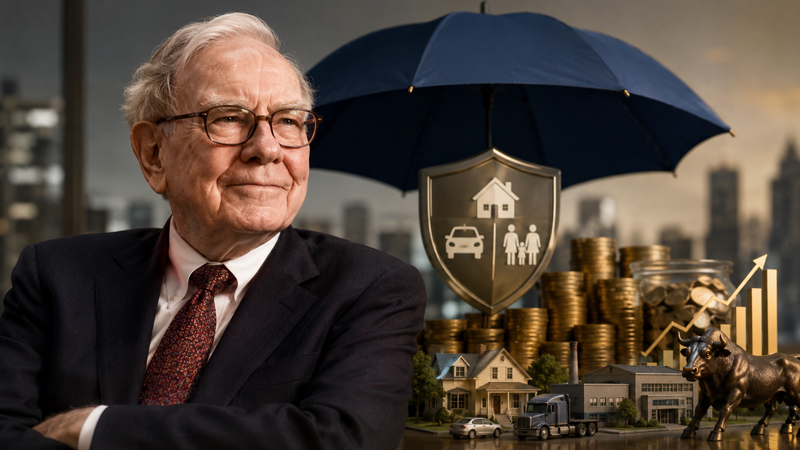
News Desk: Warren Buffett, the legendary investor known as the Oracle of Omaha, did not build his vast fortune simply by picking winning stocks or buying famous companies like Coca-Cola and Apple. At the heart of his success lies something many everyday people might overlook: the insurance business. For decades, insurance has served as the steady engine powering Berkshire Hathaway, the conglomerate Buffett transformed from a fading New England textile manufacturer into one of the world’s most valuable companies.
Buffett first gained control of Berkshire Hathaway in the mid-1960s. The company was then a traditional textile mill business facing tough competition and declining profits. Many investors might have tried to revive the factories or cut costs aggressively. Buffett, however, saw a bigger opportunity. He began shifting the company’s direction away from cloth and toward investments.
The real turning point came in 1967 when he purchased National Indemnity Company, a small but well-run property and casualty insurer based in Omaha, along with a sister company, for about $8.6 million.
At first glance, buying an insurance company might seem like an unusual move for a stock picker. But Buffett had studied the industry deeply for years. Back in 1951, as a young man, he had visited the offices of GEICO (Government Employees Insurance Company) and learned valuable lessons about how insurers operate. What fascinated him most was a simple but powerful concept called “float.”
Imagine this: when you buy car insurance or home insurance, you pay your premium upfront. The insurance company collects that money right away but usually does not pay out claims until much later; if a car accident happens or a storm damages your roof. In the meantime, the company holds onto that cash. This pool of money is the float.
For a well-managed insurer, the float can last for months or even years before claims need to be settled. Buffett realized that if you run the insurance side carefully and avoid big losses, this float acts like interest-free money you can invest elsewhere to earn returns.
It is not free money in the risky sense, poor underwriting (taking on too many bad risks or charging too little) can lead to heavy losses that eat up the float and more. But Buffett and his team focused on discipline. They sought out reliable risks, priced policies thoughtfully, and sometimes walked away from business that did not make sense.
National Indemnity specialized in unusual or hard-to-insure risks, which allowed it to charge higher premiums. Under Buffett’s ownership, the insurance operations generated profits from underwriting in many years, making the float even better than free, it came with a bonus.
The numbers tell an extraordinary story of growth. When Berkshire first entered insurance seriously, its float was modest, around $19 million or so in the late 1960s. Over the following decades, as Berkshire added more insurance businesses, that float swelled dramatically.
By recent years, it had grown to well over $150 billion. This massive pool of capital, which does not belong to Berkshire but which the company can invest, gave Buffett enormous financial firepower without the need to borrow heavily or issue new shares that would dilute owners.
Buffett did not stop with National Indemnity. In 1996, Berkshire bought a major stake in GEICO, the auto insurer famous for its gecko mascot, eventually taking full ownership. GEICO brought in huge volumes of steady auto insurance premiums.
Then in 1998 came the acquisition of General Re, a giant in reinsurance, the insurance that insurance companies buy to protect themselves from massive losses like hurricanes or earthquakes. Each addition expanded Berkshire’s capacity to underwrite more business and grow the float further. Today, insurance remains the core of Berkshire.
With this low-cost capital, Buffett could think and act like a long-term investor on a grand scale. He poured the float into stocks that he believed were undervalued, holding them for years or decades as they compounded in value.
He also used it to buy entire companies outright, everything from candy maker See’s Candies to railroads, utilities, and consumer brands. When opportunities arose during market downturns, Berkshire could move quickly with cash that was already on hand. This ability to pounce without panic has been a huge advantage.
Of course, the strategy has nuances and risks. Insurance is not immune to disasters. Big catastrophes, whether natural events worsened by climate change or unexpected events, can produce large claims. Reinsurance, in particular, can be volatile.
Buffett has acknowledged these challenges and stressed the importance of maintaining a strong balance sheet and conservative practices. Yet over the long run, Berkshire’s insurance business has not only survived but thrived, often producing underwriting profits while competitors struggled. The float has grown steadily even as the company scaled up massively.
Buffett has repeatedly called insurance the most important business at Berkshire and the engine that propelled its expansion since 1967. Without it, he has suggested, Berkshire would be worth a fraction of what it is today.
The approach highlights his broader philosophy: find a durable competitive advantage, manage risks prudently, and let time and compounding do the heavy lifting.
In an era of quick trades and high debt, Buffett’s insurance-fueled empire stands as a reminder that steady, disciplined operations can create extraordinary long-term wealth. As Buffett himself nears the end of his legendary run, with successors like Greg Abel ready to take over, the foundation he built on insurance float remains rock solid, quietly powering investments, acquisitions, and growth for generations to come.

.jpg)